

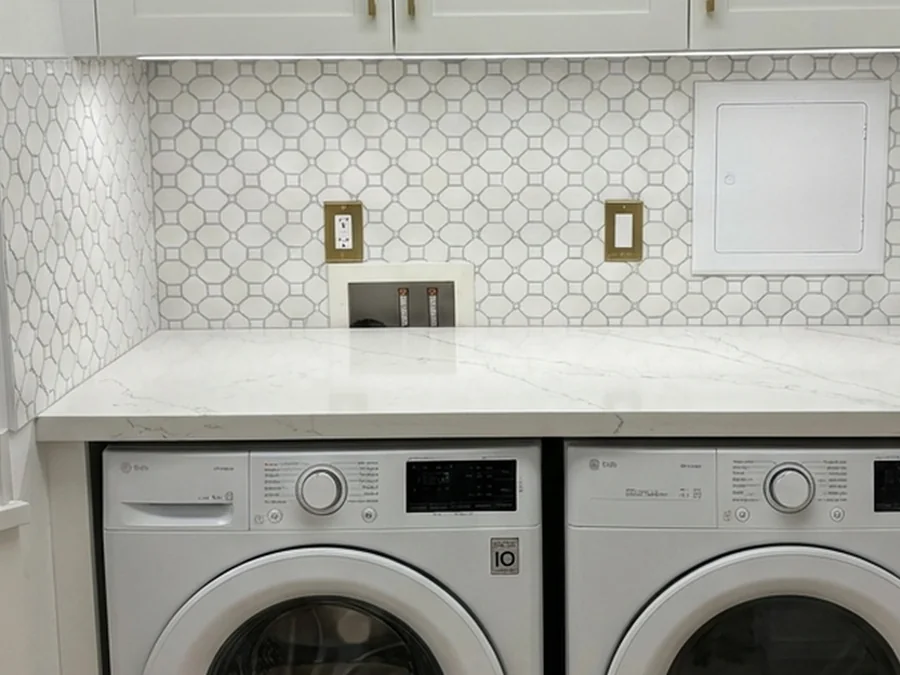
The laundry room usually becomes a holding zone before it becomes a functional room. A few cleaning supplies get dropped in. Then shoes, spare towels, pet items, and baskets of half-finished laundry start stacking up. Before long, the room works against you instead of helping you.
That’s why how to organize laundry room questions are rarely just about bins. They’re about layout, habits, storage, lighting, and materials that can hold up in a hardworking South Florida home. A well-organized laundry room can reduce laundry processing time by up to 30-50%, and families in larger homes often save 2-3 hours weekly by using zoned workflows, according to this laundry organization guide for busy families. The improvement comes from better flow, not from buying more stuff.
From Clutter to Calm An Action Plan for Your Laundry Room
Most laundry rooms don’t fail because they’re too small. They fail because nothing has a defined place and the room has no sequence. Dirty clothes come in one side, supplies are scattered, there’s nowhere to fold, and clean items end up migrating to another room.
A calmer laundry room starts with a simple rule. Organize the work before you organize the shelves. If the workflow makes sense, storage becomes much easier to maintain.
Practical rule: The best laundry rooms move in one direction, from dirty to clean, with as little backtracking as possible.
That matters more than most homeowners expect. An organized setup can cut laundry time significantly, as noted in the earlier linked source. In practical terms, that means fewer piles on the floor, fewer forgotten loads, and less frustration every week.
Quick Summary Your Path to an Organized Laundry Room
If you’re trying to get this room under control, focus on the decisions that change daily use.
- Start with a room audit: Measure the space, empty it down, and list everything that needs to live there.
- Build zones instead of random storage: Sorting, washing, drying, folding, and supply storage should each have a place.
- Use pre-sorting to reduce clutter: A divided hamper system keeps laundry moving before the first load starts.
- Store by frequency of use: Daily products should be easy to reach. Backup items can go higher or behind doors.
- Choose finishes for moisture and wear: In Florida, durability matters as much as appearance.
- Know when the scope is no longer DIY: If you’re moving plumbing, electrical, cabinetry, or venting, bring in a pro.
Assess Your Space and Define Your Goals
Before buying baskets, shelves, or cabinets, clear the room enough to see what you’re dealing with. Most homeowners skip this and start shopping too early. That usually leads to storage that doesn’t fit the room or the way the household really functions.

Start with a laundry audit
Take measurements of the floor, wall width, ceiling height, door swing, appliance size, and any window location. If you’re planning cabinetry later, note hose connections, vent locations, drain positions, and outlet placement too.
Then make a full inventory of what belongs in the room. That list often includes more than laundry supplies:
- Laundry basics: Detergent, stain remover, dryer sheets, wool dryer balls, mesh bags
- Cleaning items: Mop, broom, vacuum attachments, paper towels, rags
- Household overflow: Bulk storage, pet supplies, utility items, extra linens
- Hard-to-place pieces: Ironing board, step stool, drying rack, hampers
A room can only stay organized if it’s designed around real use. If sports gear, dog supplies, and cleaning tools always end up here, plan for them now instead of pretending they’ll disappear later.
Be honest about your household habits
At this stage, the project usually gets more useful. Ask the uncomfortable questions.
Do clothes pile up for days. Does anyone hang dry delicates. Are kids tossing everything into one basket. Do you buy supplies in bulk. Does someone in the home need easier access because bending and reaching is getting harder.
If your habits don’t match the room, the room will lose every time.
Write down a short list of priorities. Keep it practical. Good goals sound like this:
- I need a clear place to fold without using the bed
- I want hidden storage for bulk detergent and backups
- I need hampers that let us sort before wash day
- I want space to hang items right out of the dryer
- I need the room to feel easier to maintain, not prettier for one week
Match the goal to the scope
Some rooms need only better systems. Others need a full reset with cabinetry, counters, a sink, and better lighting. If your current laundry area is a closet with no landing surface, no ventilation strategy, and no useful storage, no amount of decorative bins will solve the core problem.
Planning Your Laundry Room Layout and Zones
The strongest laundry rooms are built around workflow. Not style first. Not shelving first. Workflow first.
A zoned layout mirrors the order you already use when doing laundry. According to this guide on organizing a laundry room with zoned workflow, establishing sequential zones for sorting, washing, and folding or drying can reduce chore time by 25-40% by cutting backtracking.

For homeowners comparing options, these laundry room layout ideas are a helpful starting point.
The three core zones
The simplest plan has three main working areas.
Sorting zone
Put this near the entry or where dirty laundry naturally lands. This area should hold divided hampers or clearly separated baskets so lights, darks, towels, and delicates don’t mix.Washing zone
This zone centers on the washer and dryer. Detergent, stain treatment, pods, dryer balls, and lint disposal should sit close enough that you aren’t walking around the room hunting for them.Folding and drying zone
This is the one many rooms miss. You need a usable surface for folding and a place to hang items that shouldn’t wrinkle or go in the dryer.
What the layout should feel like
A good layout has a natural sequence. Dirty laundry comes in, gets sorted, gets washed, moves to drying, then lands on a folding surface with storage nearby for clean items or supplies. You shouldn’t need to cross the room repeatedly or set clean clothes on top of clutter.
Here’s a simple way to approach it:
| Zone | What belongs there | What often goes wrong |
|---|---|---|
| Sorting | Hampers, divided bins, stain drop spot | One oversized basket creates pileups |
| Washing | Detergent, stain treatment, trash, lint bin | Supplies stored too far from machines |
| Folding and Drying | Countertop, hanging rod, drying rack | No landing space for clean clothes |
Apply zoning to the room you have
Not every laundry room is a full utility room. Some are narrow pass-through spaces. Some are hallway closets. Some are tucked behind doors in a mudroom.
That’s fine. The zones can be vertical, not just horizontal.
- Side-by-side machines: Add a counter above front-load units for folding.
- Stacked units: Use adjacent tall storage and a nearby pull-out or wall-mounted work surface.
- Closet laundry: Put sorting below, supplies above, and a fold-down drying or folding element on the wall.
- Galley layout: Keep one side for appliance work and the other for storage or sink functions.
A small room can still work well if each task has a dedicated home.
Don’t overbuild the wrong feature
Homeowners sometimes devote too much space to decorative shelving and not enough to the actual work. Open shelves with matching jars can look clean in photos. But if there’s nowhere to sort or fold, the room still won’t function.
A remodeler’s approach is simpler. Start with appliance clearances, storage needs, and a folding surface. Then add the attractive layer after the room works.
Creating Efficient Sorting and Workflow Systems
Once the layout makes sense, daily systems keep it from sliding back into clutter. These systems determine whether organization either sticks or fails.
The biggest improvement usually comes from sorting before wash day. According to this laundry room organization article on labeled bins and baskets, a labeled bin and basket system increases long-term organization success by 80%, and surveys of more than 1,000 families found that 90% of disorganized rooms lacked this basic setup.

Build a sorting system people will actually use
A single deep hamper is easy to buy and hard to live with. It turns laundry day into a sorting session before the work even starts.
Better options include:
- Three separate baskets: Simple and flexible if floor space allows
- A rolling sorter: Useful when the room also serves as storage or utility space
- Cabinet pull-outs: Best for a cleaner look and easier containment
- Stackable bins: Helpful in tight closets where width is limited
Labels matter more than people think. If you have multiple users in the house, remove guesswork. “Lights,” “Darks,” and “Towels” works better than expecting everyone to remember your system.
Create one station for the small stuff
Small items create visual clutter fast. Pods, dryer sheets, clothespins, mesh bags, stain pens, and loose socks all need a home.
A practical setup usually includes:
- A stain tray or caddy: Keep stain remover, a small brush, and treatment products together
- A lint and trash container: It should be near the dryer, not across the room
- Clear containers for loose items: You can see what’s running low without opening multiple doors
- Hooks or holders: Give the ironing board, drying rack, and step stool a dedicated place
The room stays organized when the annoying little items stop floating around.
Design for the first five minutes
Most clutter doesn’t build during the full laundry cycle. It builds in the first few minutes when someone drops a pile, leaves a bottle on top of the machine, or doesn’t know where something belongs.
That’s why the “entry moment” matters. If dirty clothes can be sorted immediately and supplies are obvious and reachable, the room stays under control with less effort.
Choosing the Right Storage and Cabinetry
Storage is where homeowners often overspend in the wrong place or underspec the room entirely. The right answer depends on how visible the room is, how disciplined you are with upkeep, and whether the room has to carry more than just laundry.

In compact rooms, integrated storage can make a real difference. According to this custom laundry room organization resource, custom storage with labeling systems can increase usable space by 50-60% in 40-60 square foot rooms, and vertical storage with labeled hamper divisions can cut sorting time by 50-70%.
If you’re comparing built-in options, these laundry storage solutions show the range between basic utility setups and more custom cabinetry.
Open shelving
Open shelves are affordable and easy to install. They work well for daily-use products, decorative containers, and items you want to reach quickly.
The downside is maintenance. Open shelving looks organized only when it is organized. In a busy family home, that can become visual noise fast.
Open shelves usually work best when:
- You keep the product list short
- You decant small items into consistent containers
- You pair shelves with at least some closed storage
- The room isn’t already carrying extra household overflow
Closed cabinetry
Upper and lower cabinets give the room a calmer appearance. They hide backups, bulk products, cleaning tools, and the odd items that don’t photograph well but are part of real life.
This is usually the better choice when the laundry room opens to a kitchen, hallway, or mudroom. It’s also useful when the space doubles as a utility room.
Look for materials and finishes that can handle moisture and repeated cleaning. In Florida homes, that matters more than a trendy door style.
A quick comparison helps:
| Storage type | Best for | Trade-off |
|---|---|---|
| Open shelving | Fast access, lower cost, lighter look | Requires tidy habits |
| Closed cabinetry | Hidden storage, cleaner appearance | Higher cost |
| Modular wall systems | Flexible setup, adjustable parts | Can look pieced together |
| Custom built-ins | Exact fit, strongest workflow integration | More planning and investment |
A short walkthrough can help you think through cabinet and shelf choices in a real room:
Modular systems and custom work
Modular systems can work well in secondary spaces, especially when you need a fast upgrade without changing the room structure. They’re flexible, but they don’t always solve awkward corners, appliance clearances, or uneven walls cleanly.
Custom built-ins are the better solution when every inch matters. That includes narrow rooms, stacked appliance layouts, multi-use utility spaces, and homes where the laundry room needs to feel integrated with the rest of the interior.
What custom work does best:
- Fits around exact appliance dimensions
- Creates pull-outs, hampers, and drying features where standard products can’t
- Uses ceiling height more efficiently
- Makes the room look intentional instead of assembled over time
Selecting Surfaces Lighting and Finishes
This room needs materials that can handle water, detergent, vibration, and daily wear without becoming high maintenance. That’s why the best finish selections are usually the least fussy ones.
Surfaces that hold up
For countertops, non-porous materials are the practical choice. Quartz and laminate are both easy to wipe down and don’t ask much of the homeowner. In a laundry room, that matters more than having the most expensive slab in the house.
For flooring, choose something that handles moisture well and is easy to clean. Porcelain tile and LVP are common for good reason. They work hard, they clean up well, and they don’t turn a utility room into a maintenance project.
If you’re adding a sink, choose one that suits the task. A deep utility sink is usually more useful than a decorative sink that looks better than it works.
Light the work, not just the room
Many laundry rooms have one ceiling fixture and too many shadows. That’s not enough for stain treatment, folding, reading care labels, or cleaning.
Use layered lighting:
- Ambient light: General room illumination from recessed or flush-mount fixtures
- Task light: Under-cabinet strips or directed light over counters and sinks
- Accent light: Optional, but useful if the room is visible from nearby living areas
If your room has awkward wiring or limited overhead options, this guide on light a room with no overhead lighting is worth reading for practical fixture strategies. For broader renovation planning, this look at the impact of lighting choices in whole house remodels helps connect laundry room lighting to the rest of the home.
Better task lighting changes how the room feels to use. It’s one of the least glamorous upgrades and one of the most noticeable.
Finishes that make sense in South Florida
Avoid finishes that need babying. The laundry room is a work zone. Sheen levels that clean easily, cabinet finishes that tolerate humidity, and hardware that won’t feel sticky or corroded over time all tend to age better.
Ventilation matters too. In our climate, the room should not trap damp air. A laundry room that looks good but stays humid will not stay good for long.
Local Note Jupiter and Palm Beach County
Laundry room projects in Jupiter and nearby communities come with a few realities that should shape the plan early.
Humidity changes the material conversation
South Florida homes deal with moisture year-round. In a laundry room, that means unsealed wood, low-grade shelving, and poorly protected finishes can become a problem faster than homeowners expect. Materials that perform well in a dry climate don’t always hold up the same way here.
That’s one reason to be careful with exposed wood shelving and bargain cabinet interiors. Sealed surfaces, moisture-tolerant cabinetry, and easy-clean finishes are usually the safer long-term choice.
Community approvals can affect the schedule
If your project involves more than organization, approvals may enter the picture. Condo buildings and HOA communities often have their own requirements around contractor paperwork, working hours, noise, protection of common areas, and scope approvals.
That matters especially when the project includes moving outlets, venting, plumbing, or wall layouts. It’s better to verify those requirements before ordering materials.
Living in the house during the work takes planning
Laundry room remodels sound small until the room is offline and your routine disappears. If the home is occupied during construction, plan where laundry will happen temporarily, how the area will be contained, and how nearby rooms will stay usable.
A calm schedule and clean sequencing make a big difference here. This is one of those spaces where a little planning saves a lot of frustration.
Sequencing matters more than people expect
Cabinets, appliances, electrical, plumbing, countertops, and trim all depend on one another. If one decision lands late, the rest can bottleneck. In a custom room, especially, appliance specs and cabinetry should be coordinated early so the finished room doesn’t get compromised by rushed changes.
What We See on Real Projects
The same issues show up again and again in real homes, even in well-kept ones.
The folding surface gets ignored
This is probably the most common miss. Homeowners focus on machines, then cabinets, then color. Meanwhile, there’s no real place to fold clothes. The result is predictable. Clean laundry leaves the room and lands on a bed, sofa, or chair.
A counter over front-load units solves this cleanly in many homes. In other layouts, a dedicated work surface or pull-down station makes more sense.
Stackable isn’t always the best answer
Stacking appliances can save floor area, but it isn’t always the most comfortable setup for daily use. Reaching the upper controls or unloading the top unit can be awkward for many homeowners.
For aging-in-place planning, ergonomics matter. In Palm Beach County, 22% of the population is over 65, and accessible details such as counter heights of 34-36 inches, pull-out hampers at waist level, and reachable appliance controls are especially important, as noted in this article discussing laundry room accessibility considerations.
The room should work for the person using it most often, not just for the floor plan.
Utility sinks keep earning their place
Homeowners sometimes question whether a utility sink is worth the space. In practice, it often becomes one of the most appreciated features in the room. It handles stain treatment, hand-washing, soaking, plant cleanup, and the household tasks that don’t belong in a kitchen sink.
Lighting gets treated as an afterthought
People tend to notice cabinets first and lighting later. But on finished projects, task lighting is one of the things clients mention right away. Good light over the counter and sink makes the room easier to use every single day.
Mistakes to Avoid
Most laundry room problems are easy to predict before the work starts.
- Finalizing cabinets before choosing appliances: Get the exact washer and dryer specs first, including door swing and connection clearances.
- Ignoring venting details: Dryer vent routing needs to be thought through early, especially if the room layout is changing. For maintenance guidance, this article on dryer vent cleaning for fire safety and efficiency is a useful reference.
- Choosing decorative fixtures over useful ones: A shallow sink may look refined, but it won’t help much when you need to soak or scrub.
- Skipping landing space: You need somewhere to set a basket while unloading. Without it, clean clothes end up balancing on machines or the floor.
- Treating electrical and plumbing moves like minor edits: They aren’t. Once you relocate outlets, drains, or water lines, the project becomes much more technical.
Worth remembering: The expensive mistakes usually happen before the first cabinet goes in. They start with assumptions, bad measurements, or underestimating the systems behind the walls.
When to Call a Pro
If you’re adding freestanding shelves, labels, and baskets, that can absolutely be a DIY project. But once the plan changes the room itself, the conversation shifts.
Call a pro when the scope includes things like:
- Moving plumbing lines or adding a sink
- Relocating or adding electrical outlets
- Changing vent routes or appliance locations
- Installing built-in cabinetry and counters
- Reworking walls, doors, or circulation
- Trying to balance function, finish quality, and long-term durability in one plan
Depending on scope, especially electrical, plumbing, or structural work, this may require a permit. A licensed contractor can confirm requirements and handle permitting.
The value of a design-build approach is coordination. In a laundry room, small measurement errors and sequencing problems can create visible, expensive consequences.
Your Next Step
A laundry room doesn’t need to be large to work well. It needs a clear layout, sensible storage, durable materials, and enough thought behind the daily routine. When those pieces are handled correctly, the room feels easier almost immediately.
If your current space is beyond baskets and shelf brackets, it may be time to treat it like a real remodeling project instead of a storage problem.
If you’re ready to create a laundry room that works better for your home in Jupiter or Palm Beach County, schedule a consultation with MELTINI Remodeling.