

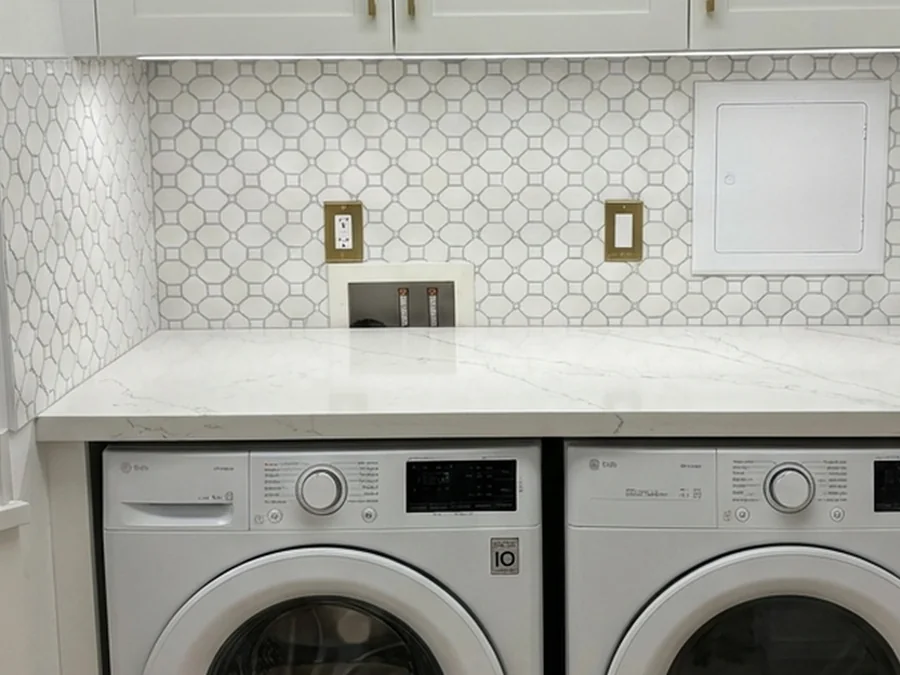
If your back door area has turned into the place where sandy flip-flops, gym bags, damp towels, pet gear, and laundry baskets all collect, the problem usually isn’t clutter. It’s that the house doesn’t have a dedicated system for handling daily traffic. In Jupiter homes, that issue shows up fast because people are moving between outdoors and indoors all day, often with wet gear, sunscreen, pool towels, or shoes carrying grit.
A well-planned mudroom and laundry room combo gives that mess a place to stop. It creates a transition zone, keeps laundry from spilling into living areas, and makes storage work harder. The best versions aren’t decorative afterthoughts. They’re built around routine, moisture control, and materials that hold up in South Florida conditions.
Introduction
Most homeowners start thinking about this remodel after a stretch of small frustrations. Shoes pile up by the garage door. Backpacks land on the kitchen counter. Clean laundry gets folded on a dining chair because there’s no real work surface where the machines are. In a busy household, those little problems repeat every day.
A combined utility space fixes that by giving one room several jobs. It becomes the drop zone, the wash area, the supply cabinet, and often the pet station too. When it’s planned properly, the room feels calm even when it’s working hard.
This is where good remodeling decisions matter. Layout, venting, flooring, cabinet construction, and storage details all affect whether the room stays useful or starts fighting you after a few months.
Quick Summary of the Remodeling Process
- Start with daily habits. Track what comes into the room, who uses it, and where traffic bottlenecks happen.
- Build the layout around workflow. Entry, storage, and laundry tasks should support each other instead of competing for the same floor space.
- Get the infrastructure right. Plumbing, power, dryer venting, and moisture control are the parts you don’t want to compromise.
- Choose materials for Florida conditions. Humidity, sand, and salt air are hard on finishes.
- Use built-ins deliberately. Good storage reduces visual clutter and makes the room easier to maintain.
Assessing Your Family’s Needs and Daily Flow
Before choosing tile or cabinet color, look at how the room needs to function. A mudroom and laundry room combo works best when it solves your household’s specific traffic pattern, not when it copies a photo you liked online.

Start with entry habits
In many Jupiter homes, the main entry door isn’t the front door. It’s the garage entry, side door, or a path from the pool or backyard. That matters because the room has to handle the way people really move through the house.
Ask yourself a few direct questions:
- Which door gets the most use
- What lands on the floor first
- What items need a permanent home
- Does anyone need to sit to remove shoes
- Do wet items need to air dry
- Does the dog come through this space after walks or beach trips
The answers shape everything. If children drop sports bags and shoes the minute they come in, open cubbies and hooks near the door matter more than decorative upper cabinets. If you wash towels constantly, countertop space near the machines becomes more important than a bench.
Practical rule: Design for the first thirty seconds after someone walks in. That’s when clutter either gets contained or spreads into the house.
Define the room by zones
Trying to make every wall do every job usually creates a cramped room. It’s better to break the space into working zones. In most projects, that means some version of these:
- Entry zone with hooks, a bench, shoe storage, and a surface for keys or mail
- Laundry zone with washer, dryer, supplies, sorting space, and hanging space
- Overflow storage zone for bulk paper goods, pet food, cleaning tools, or seasonal items
- Wet zone if the room needs to handle damp towels, umbrellas, swimsuits, or pet cleanup
Those zones don’t need separate rooms. They do need clear priorities.
A family with school-age kids may need lockers and shoe storage first. A retired couple may want closed cabinetry, a tall broom closet, and a better place for folding and ironing. A household with pets often benefits from easy-clean flooring, a leash station, and storage for food and towels near the door.
Look for the recurring friction points
Walk through a normal weekday in your head. Then list what goes wrong.
Maybe clean clothes have nowhere to go, so they stay in baskets. Maybe muddy shoes sit under the washer because there isn’t a tray or cubby. Maybe everyone drops bags on top of the dryer. Those are not style problems. They are workflow problems.
Here are the clues that usually show up during planning:
- Countertop shortage means laundry tasks spill into other rooms
- No drop zone means clutter migrates to kitchen counters
- Too few hooks means jackets end up on chair backs
- No closed storage means supplies stay visible and the room always looks busy
- Poor separation between wet and dry items leads to odor and moisture issues
A good design gives each of those habits a home. That’s what makes the room easier to keep organized without constant effort.
Layout and Space Planning Essentials
A combined room can work in a modest footprint, but size still affects comfort. Industry guidelines call 6 feet by 8 feet, or 48 square feet, the minimum for a functional combined space, while 8 feet by 10 feet, or 80 square feet, is more comfortable. Typical combined rooms often fall in the 50 to 150 square foot range, which leaves room for folding counters, benches, and cabinetry, according to combined mudroom and laundry room sizing guidance.

Match the layout to the room shape
Not every footprint wants the same plan. The strongest layouts usually fall into three categories.
| Layout type | Where it works | What it does well | Common downside |
|---|---|---|---|
| Galley | Narrow rooms or pass-through utility spaces | Keeps appliances and storage efficient along one or two walls | Can feel tight if door swings and traffic paths conflict |
| L-shape | Corner rooms with a bit more width | Separates laundry from entry storage better | Corner cabinet planning needs to be deliberate |
| U-shape | Larger enclosed rooms | Maximizes counter and storage capacity | Can overfill the room if aisle space gets pinched |
A galley layout often makes sense when the laundry room sits between the garage and kitchen. One wall can carry the machines and upper cabinets, while the opposite side handles hooks, a bench, and tall storage. It’s simple and usually cost-conscious because utilities stay concentrated.
An L-shape gives you better zoning. One leg can be all utility. The other can act as the mudroom side. That separation makes the room feel less like a laundry closet and more like a planned transition space.
Keep the work path short and logical
You don’t need a formal triangle the way kitchens do, but you do need a sensible sequence. Dirty items should come in, land somewhere intentional, move to the washer, then to drying, folding, hanging, or storage without crossing the room repeatedly.
That usually means placing these features in a logical order:
- Drop point near the door
- Hampers or sorting area
- Washer and dryer
- Counter or hanging rod
- Cabinet storage for supplies
When the sequence gets reversed, the room starts to feel awkward fast. A beautiful bench across from the entry doesn’t help much if everyone has to carry sandy towels around it to reach the washer.
For more examples of how that sequence can work in different room shapes, laundry room layout ideas are useful for comparing practical footprints.
If the room is narrow, every door swing matters. Appliance doors, entry doors, and cabinet doors can all compete for the same few feet.
Use space where it counts
Homeowners often focus on fitting more cabinetry into the room. The better question is whether the room still has enough open space to move, sort, and use the appliances comfortably.
A few planning choices usually improve function more than adding another cabinet box:
- Put the folding counter where it’s immediately usable. Across from the machines can work, but over front-load units is often the most efficient use of space.
- Reserve the closest wall to the door for daily items. Shoes, bags, keys, and towels should not require crossing the room.
- Use vertical height wisely. Tall cabinets, upper shelves, and stacked storage can free the floor for movement.
- Don’t overbuild the bench. If the bench steals aisle width, it can create more frustration than convenience.
Plan for future use, not just today
A room designed only for your current routine can become obsolete faster than you think. Children grow. Sports change. Pets age. A side-by-side laundry pair may eventually become stacked, or the opposite.
That’s why flexible storage matters. Adjustable shelves, removable rods, and cabinetry that can shift from school gear to household supplies will age better than highly specialized built-ins in every corner.
The right space plan feels slightly underfilled on day one. That’s usually a sign it has room to work well long term.
Plumbing Electrical and Ventilation Realities
This is the part homeowners don’t see once the walls are closed, but it’s what determines whether the room performs properly. In a mudroom and laundry room combo, the visible finishes matter less than the quality of the infrastructure behind them.
Plumbing needs to support the layout
The washer location isn’t just a design choice. It has to work with supply lines, drain placement, shutoff access, and the practical limits of the room. Moving the laundry zone can be worthwhile, but it has to be done with a clear plan for drainage and serviceability.
A washer box should be easy to reach. The drain setup needs to be installed correctly. If you’re adding a utility sink, pet wash area, or extra water source, that complexity increases and coordination matters more.
Depending on scope, keeping the washer and sink on the same side of the room can simplify rough-in work and reduce unnecessary disruption behind finished walls.
Electrical has to match real use
Laundry equipment places specific demands on the electrical plan. The dryer, lighting, receptacles, and any extra appliances all need to be considered together. This is not the place for guesswork or piecemeal upgrades.
Outlets near water sources need the proper protection. Lighting should include both room light and task light. If the room will also charge cordless tools, run a second refrigerator, or support a pet-care station, those loads need to be reviewed during planning instead of tacked on later.
Behind-the-walls priority: A room that looks clean but has poor access to shutoffs, weak lighting, or inadequate power never feels finished in daily use.
Ventilation matters more in South Florida
In this climate, ventilation is not optional. The dryer vent is only one part of the moisture equation. The room itself also needs a strategy for removing humid air and preventing lingering dampness.
Dryer vent routing should be as direct and efficient as the house allows. Long or awkward runs can reduce performance and make maintenance harder. Homeowners who want a clear overview of what proper exterior venting should account for can review dryer vent installation done right, especially when comparing possible vent paths during planning.
Beyond the dryer, many combo rooms benefit from a dedicated exhaust approach, especially if the space also handles wet towels, pool items, or pet cleanup. In South Florida homes, moisture tends to collect. By the time cabinet corners, grout lines, or stored items show the problem, the room has already been staying damp too long.
Permits and coordination
Depending on scope, especially electrical, plumbing, or structural work, this may require a permit. A licensed contractor can confirm requirements and handle permitting.
That matters because these rooms often involve several trades in a compact space. Plumbing rough-in, electrical rough-in, vent placement, insulation, drywall, flooring, cabinetry, countertop templating, and finish connections all have to happen in the right order.
Homeowners usually feel the benefit of good coordination in one simple way. The room functions the way it was drawn, with no awkward compromise added late because a vent, outlet, or valve was overlooked.
Choosing Durable Materials for South Florida Homes
Material choice makes or breaks this kind of room in our area. A surface can look great in a showroom and still be the wrong fit for a Jupiter home with humidity, sand, wet towels, and frequent traffic through one entry point.

Flooring should be easy to clean and hard to damage
This room gets grit, moisture, detergent drips, and heavy foot traffic. That’s why flooring needs to be selected for maintenance and durability first, appearance second.
Porcelain tile remains a strong option because it handles moisture well and cleans easily. Luxury vinyl plank can also work in the right installation, especially when comfort underfoot matters and the product is appropriate for a utility environment. What usually disappoints in this room are finishes that are too delicate, too porous, or too dependent on perfect conditions.
If you’re comparing surfaces for durability, cleaning, and how they behave in a humid home, this guide on how to choose flooring is a useful place to sort through the trade-offs.
Cabinet boxes and finishes need to resist moisture
Cabinetry in a laundry-adjacent space doesn’t get the same protection as a dining room built-in. Doors get touched with damp hands. Toe kicks take hits from shoes and baskets. Interiors hold cleaning products, towels, and sometimes items that never fully dry before being put away.
In Florida, average humidity around 75% annually makes moisture-resistant cabinetry an important part of long-term performance, as noted in guidance on laundry mudroom combos in humid climates. That same source notes that functional utility spaces can boost resale value by 8 to 12 percent in family-oriented markets like Palm Beach County, while poorly planned rooms in flood-prone areas can affect insurance costs if elevation and drainage aren’t handled properly.
That’s why I prefer cabinet construction and finishes that are chosen for stability, not just color. The goal is to limit swelling, peeling, and edge failure over time.
A few material priorities tend to hold up well:
- Moisture-aware cabinet construction instead of the least expensive box option
- Durable finish systems that are easier to wipe clean and less prone to breakdown
- Non-porous countertops that won’t absorb spills from detergents or damp items
- Hardware with corrosion resistance where salt air may be part of the equation
Countertops and details should lower maintenance
Quartz is often the practical choice here because it is non-porous and easy to maintain. In a utility room, that matters more than subtle veining or prestige material names. Laundry products, damp clothes, and daily friction are hard on surfaces.
Natural stone can work in some applications, but porous materials ask for more vigilance. In a room used for folding, sorting, and handling household mess, the lower-maintenance option often ends up being the better long-term investment.
The room should be easy to wipe down at the end of a normal day. If a finish needs special handling to survive routine laundry use, it’s usually the wrong finish.
Humidity control is part of material strategy
Moisture management isn’t only mechanical. It also affects what products belong in the room. The same humid-climate source notes that smart humidity sensors can reduce energy costs by 15% through automated venting in the right setup. That doesn’t mean every room needs a gadget-heavy approach. It does mean humidity should be considered from the beginning.
When finishes, venting, cabinet design, and storage habits all support drying out the room properly, the space ages much better. That’s the difference between a room that stays crisp and one that starts showing soft spots, musty smells, or finish failure.
Smart Storage and Organization Solutions
Storage is what turns a combined room from a pass-through into a system. Without it, the space becomes a nice-looking laundry room with a shoe pile in the corner.

Give every repeat item a home
Think about the things that show up in this room every day. Shoes. Backpacks. Reusable grocery bags. Dog leashes. Pool towels. Detergent. Mail. If even half of those items don’t have assigned storage, they’ll end up on the nearest flat surface.
One of the most useful principles from smaller-space design is that storage works best when it’s both visible enough to use and specific enough to maintain. These smart storage solutions illustrate that idea well, especially the way vertical and concealed storage can reduce clutter without making a room feel overbuilt.
In this room, built-ins usually outperform freestanding pieces because they use depth and height more efficiently. A bench with drawers does more than a loose bench. Full-height cabinets do more than a row of hooks with baskets underneath.
Lockers, benches, and hidden hampers
The most successful family setups usually assign storage by person, not just by category. When each family member has a predictable place for daily items, cleanup gets simpler.
Useful combinations include:
- Individual lockers for backpacks, jackets, and sports gear
- A bench with cubbies or drawers so shoes don’t spread across the floor
- Pull-out hampers for sorting laundry before it reaches the machines
- Upper cabinets for detergents and items that shouldn’t stay within easy child reach
- Tall utility storage for brooms, mops, and bulk household supplies
The room doesn’t need to look commercial. It just needs clear destinations.
For homeowners thinking through cabinet configurations, pull-outs, bench storage, and custom built-ins, laundry storage solutions can help narrow down what belongs in the plan and what can be left out.
Add small features that reduce daily friction
The details that save the most frustration are usually modest. A hanging rod for shirts straight from the dryer. A tray for wet shoes. A charging drawer or shelf for phones. A narrow ledge for keys and mail that keeps those items off the folding counter.
Here’s a useful visual reference for how layered storage features can work together in one room:
A few additions are especially useful in active South Florida homes:
- Towel storage near the entry point if the room catches pool or beach traffic
- Ventilated cubbies for shoes and damp gear
- A drying rack that folds away instead of taking permanent floor space
- A wipeable drop surface for sunscreen, sunglasses, and everyday carry items
Storage should match behavior. If the easiest place to drop an item is the countertop, that countertop will become storage whether you planned for it or not.
Local Note Jupiter and Palm Beach County
Remodeling this room in our area comes with a few realities that national design articles usually skip.
First, HOA and condo rules can affect more than people expect. Work hours, delivery access, parking, debris handling, and approval steps can all influence how the project gets scheduled. If you live in a managed community, review those requirements early.
Second, humidity and salt air affect product choices. Exterior vent covers, nearby hardware, and any metal exposed to outside conditions should be selected with corrosion in mind. A room near a garage entry or coastal exposure benefits from materials that can tolerate more than light indoor wear.
Third, project planning should respect storm season and daily weather patterns. Even when the remodel is indoors, material deliveries, site protection, and temporary openings need to be handled carefully. If the room connects directly to the garage or exterior, protecting the home during construction matters more in this climate.
A few local habits also shape design:
- Pool and beach traffic often need as much consideration as school or work traffic
- Bulk storage matters because many homeowners use warehouse shopping and need space for household supplies
- Living-in-place planning is important when the laundry is the home’s only laundry area
These details don’t make the project harder. They just reward better planning.
What We See on Real Projects
The combined layout became much more common after 2010 as open-concept homes pushed utility functions to work harder, and combining the two spaces can reduce remodel expense by 20 to 30 percent by sharing plumbing and electrical infrastructure, according to combined mudroom laundry room remodeling observations.
What we see most often is that homeowners underestimate how much the room needs to do. They plan for appliances and a few hooks, then realize later they still have nowhere for shoes, towels, backpacks, pet items, and cleaning supplies. The result is a room that looks finished but still feels cluttered.
A few patterns show up repeatedly on real jobs:
- Long interior dryer vent runs tend to create avoidable design headaches
- Ventilation gets undervalued until moisture starts collecting in cabinets or corners
- The folding surface is often too small because storage was given too much priority
- Lighting is treated as basic utility lighting when the room really needs task visibility
- Rough-in decisions drive the finish plan more than most homeowners expect
We also see that assigned personal storage works better than open shared space. The source above notes that designs with at least two lockers per family member are especially effective for handling seasonal gear and daily items. In practice, that kind of structure helps keep the room organized because everyone knows what belongs where.
One other point matters. Sequencing is not cosmetic. Rough plumbing and electrical need to be correct before walls close. After that, finish work has to follow a disciplined order so cabinets, flooring, trim, and connections all land cleanly.
Mistakes to Avoid
A lot of disappointing utility rooms fail for ordinary reasons, not dramatic ones. The room gets built, but key decisions were too shallow during planning.
The first mistake is treating the room like a laundry closet with extra hooks. If the entry side isn’t given enough thought, the clutter just relocates. You still end up with shoes on the floor and bags on the counter.
Another common issue is skipping a real folding surface. Homeowners assume they’ll manage with the top of a front-load pair or a small side counter. Then the room is in daily use and there’s no comfortable place to sort or fold.
Watch for these misses during design:
- Too little lighting for stain treatment, sorting, and cleaning
- No dedicated drop zone for keys, mail, sunglasses, and phones
- Porous or high-maintenance finishes in a damp, sandy room
- Bench seating that crowds the aisle
- Open shelving everywhere when many households need concealed storage
A subtler mistake is designing around a perfect day instead of a messy one. The room has to work when someone walks in with wet towels, a dog leash, school bags, and a basket of laundry at the same time. If the layout only feels good when everything is already tidy, it isn’t finished planning yet.
When to Call a Pro
Some homeowners can handle paint, accessories, or simple storage changes on their own. A full combo remodel is different once the plan touches utilities, structure, or custom built-ins.
Call a professional when the project involves moving plumbing, rerouting venting, changing electrical service, altering walls, or solving moisture issues that aren’t purely cosmetic. Those decisions affect safety, function, and inspection path. If you’re unsure whether the warning signs point to a larger plumbing problem, these signs it's time to call a plumber are a useful baseline.
A design-build approach also helps when you want one team to coordinate layout, cabinetry, finishes, and trade sequencing. Depending on scope, especially electrical, plumbing, or structural work, this may require a permit. A licensed contractor can confirm requirements and handle permitting.
Next Step
If you’re at the point where the house needs a better drop zone, better laundry function, and materials that can handle South Florida conditions, the next move is a measured plan. One good conversation usually clarifies layout priorities, storage needs, and which parts of the project need professional coordination.
If you’d like help planning a mudroom and laundry room combo that fits your home in Jupiter or Palm Beach County, MELTINI Remodeling offers design-build remodeling for laundry, utility, and built-in storage spaces. Schedule a consultation.