

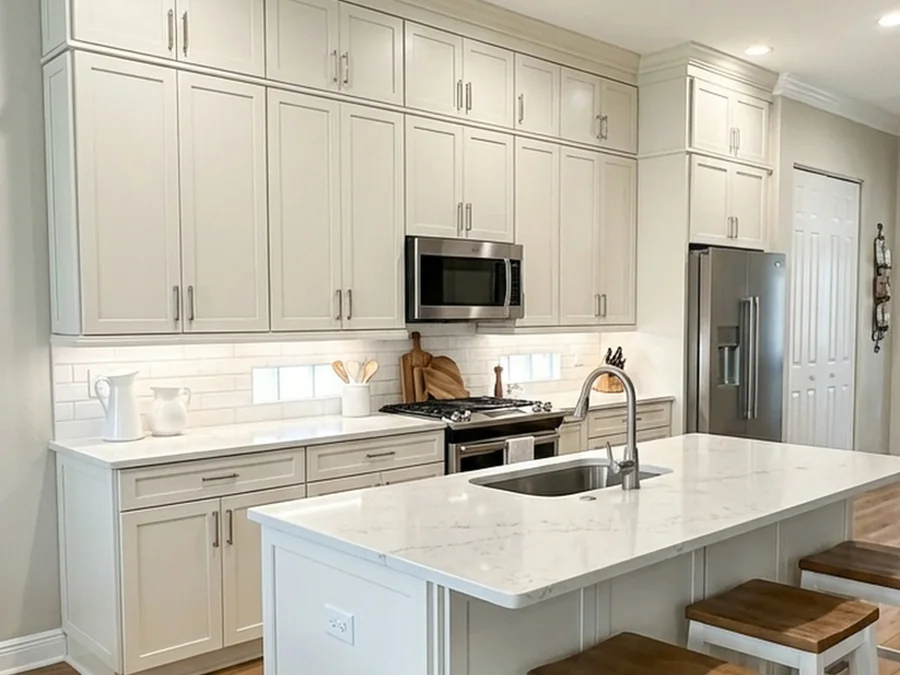
TL;DR: For Palm Beach County homeowners, a kitchen renovation usually takes longer than the cabinet install and countertop template alone. A straightforward kitchen update often runs about 6 to 12 weeks once construction starts. A larger renovation with layout changes, permits, or structural work can stretch to 3 to 5 months in the field. Before any of that, design development, selections, ordering, permitting, and HOA review can add several more weeks, and in many homes that front-end work determines whether the build stays controlled or starts slipping.
A common starting point is a family standing in a kitchen they already know is not working, trying to map out real life during the renovation. Where does breakfast happen. Where do groceries go. How long does the temporary sink setup need to last. In a primary home, those questions matter just as much as the finish selections.
The honest answer is that there is no single timeline that fits every kitchen. Scope drives the schedule. So do decision speed, permit requirements, inspection timing, and whether materials are in hand before demolition begins.
Palm Beach County adds its own timing realities. Municipal permitting can affect the start date. HOA or condo approvals can add another layer before work begins. Imported tile, custom cabinetry, specialty appliances, and stone slabs do not all move on the same schedule, especially during busy seasonal periods. That is why a realistic kitchen timeline in Jupiter, Palm Beach Gardens, or elsewhere in the county needs to be built around local conditions, not just a national average.
Your Kitchen Renovation Timeline A Practical Introduction
Most families don't start with design plans. They start with logistics. Where will the coffee maker go, how will kids eat breakfast before school, and can anyone still work from home while trades are moving through the house?
That’s why timeline conversations need to be practical, not abstract. A kitchen renovation affects routines more than almost any other room. If the project is organized well, the disruption feels manageable. If decisions are rushed or materials arrive out of sequence, the same project can drag and become far more stressful than it needed to be.
In real projects, the construction phase is only part of the story. The planning, selections, ordering, and approvals are what determine whether the job moves cleanly once demo starts. Homeowners usually feel better once they understand that early planning isn’t “extra time.” It’s the part that protects the build.
Practical rule: The smoothest kitchen renovations are usually the ones that look slower at the beginning because the decisions are handled before walls come open.
If you're trying to answer how long does a kitchen renovation take, it helps to think in three layers:
- A small refresh can move quickly if it avoids major trade work.
- A mid-range renovation often has a reasonable construction window, but only after selections are complete.
- A full overhaul takes longer because the schedule has more dependencies, more inspections, and more chances for hidden conditions behind walls.
Typical Timelines by Renovation Scope
The biggest mistake in timeline planning is using one average for every kitchen. Scope drives everything.

The Minor Refresh
This is the category many homeowners underestimate in a good way. If the cabinet boxes stay, the layout stays, and the work is mostly surface-level, the schedule can be much shorter than a full remodel.
Typical examples include:
- Cabinet refacing or repainting
- Appliance replacement
- New countertops
- Backsplash updates
- Fixture and hardware swaps
Verified guidance notes that minor remodels focused on cosmetic updates may be completed in as little as a long weekend, while more standard kitchen renovations typically require 6 to 12 weeks of construction time once materials are on-site (Chartway’s breakdown of renovation scope and duration).
That range sounds wide because “minor” still covers a lot of territory. A faucet, lighting, and paint update is not the same as replacing countertops, installing new appliances, and reworking finish carpentry.
The Mid-Range Renovation
This is the most common category for homeowners who want a kitchen to feel entirely new without moving walls. The layout may stay largely intact, but the room gets rebuilt in place with new cabinetry, countertops, appliances, lighting, flooring, and finish work.
What makes this category efficient is that the plumbing and electrical locations often stay close to where they are now. That reduces coordination and usually keeps permitting simpler, depending on the exact scope.
In practical terms, this is the kind of project many homeowners think of as “just a kitchen remodel,” but it still requires disciplined scheduling. Cabinet orders, appliance specs, countertop templating, and installation sequencing all have to line up.
A short visual can help if you're comparing project types and trying to understand why one kitchen takes much longer than another.
The Major Overhaul
A major kitchen renovation is a different class of project. Once you start altering the footprint, removing walls, moving plumbing, relocating electrical, or changing structural conditions, the schedule expands because the number of decision points expands.
These projects commonly include:
| Project element | Why it extends the timeline |
|---|---|
| Wall removal | May require engineering review, structural coordination, and additional inspections |
| Island relocation or addition | Often affects electrical, lighting, and plumbing |
| Plumbing changes | Requires rough-in work before finishes can proceed |
| Electrical reconfiguration | Adds coordination with lighting, appliance loads, and inspection timing |
| Custom cabinetry | Can create long procurement windows that affect the start of construction |
Verified guidance states that major renovations involving structural changes can extend to 3 to 5 months, and that doesn’t include the 8 to 12 week design and material selection phase before construction begins (Chartway’s planning and construction timeline reference).
A kitchen rarely runs late because one task takes forever. It runs late because ten dependent tasks can’t happen until one missing decision or one delayed item is resolved.
That’s why a realistic timeline is less about optimism and more about sequencing. The best schedule is the one built around actual selections, real lead times, and a scope that is fully defined before demolition begins.
The Anatomy of a Renovation Timeline Step by Step
A kitchen project feels much more manageable when you break it into stages. Homeowners usually feel the most uncertainty before construction begins because so much of the work is invisible at that point. In reality, that early phase is doing heavy lifting for the schedule.

Planning and design
This phase sets the direction of the whole project. Layouts are refined, appliance specifications are checked, storage needs are addressed, and finish selections begin to narrow.
Verified guidance for full renovations notes that the pre-construction planning and design phase typically spans 4 to 8 weeks, and that it can account for 60 to 70% of the total project timeline because ordering and fabrication have to align with the construction calendar (Kitchen Renovations Perfected on planning and procurement timing).
This is also where many scheduling problems are either prevented or created.
- Strong planning means the cabinet layout fits the appliance specs, the island clearances work, and the lighting plan supports the room.
- Weak planning means changes surface later, when they are slower and more expensive to fix.
For homeowners who want a more technical look at how sequencing affects residential builds, Mastering Residential Construction Project Scheduling is a useful outside read. It does a good job showing why one delayed item can ripple through the entire trade calendar.
Material selection and ordering
Selections aren't just aesthetic. They control procurement timing.
Custom cabinets often have the longest impact on the schedule. Countertops need final measurements after cabinets are installed. Appliances need to be confirmed early so cabinetry, electrical, and ventilation details don't need to be revised later. Tile, plumbing fixtures, hardware, and specialty lighting all affect field coordination.
A homeowner who picks quickly and consistently usually saves time here. A homeowner who chooses a cabinet line first, changes appliances second, and revises the layout third usually creates avoidable delay.
For a practical planning checklist before selections are finalized, this guide on how to plan a kitchen remodel is a useful starting point.
Permitting and approvals
Depending on scope, especially electrical, plumbing, or structural work, this may require a permit. A licensed contractor can confirm requirements and handle permitting.
This phase is easy to underestimate because there may be little visible activity in the home while paperwork is moving through review. But this isn’t idle time. It’s the period where plans are verified and approved so the field work can proceed correctly.
Demolition
Demolition is fast compared with planning, but it marks the moment when hidden conditions become visible. Old plumbing, electrical issues, framing irregularities, or prior unpermitted work can all show up here.
Demo should start only when the project is ready. If materials are still floating, appliance models are still changing, or permit status is unresolved, opening the room too early often creates a stalled jobsite.
Field note: Fast demolition does not mean a fast renovation. Demo only helps when everything behind it is already coordinated.
Rough-ins
At this stage, the room gets rebuilt behind the walls. Electricians, plumbers, and sometimes HVAC trades complete the rough-in work needed to support the new layout and equipment.
Rough-ins are technical and inspection-sensitive. If a receptacle location changes because an appliance spec changes, that adjustment can affect cabinetry, backsplash details, and final trim work later.
This phase usually feels slower to homeowners because a lot is happening, but the kitchen still doesn't look close to finished.
Drywall and prep work
Once rough-ins pass inspection, the room starts to look more settled. Walls are closed, repaired, and prepared for the visible parts of the renovation.
This stage matters more than people expect. Cabinet installation relies on accurate surfaces and clean dimensions. If prep work is rushed, finish problems tend to show up later where they are more frustrating to correct.
Cabinet installation
Cabinets are one of the biggest turning points in the project. Once they’re set, the room becomes legible. You can finally see aisle widths, island proportion, appliance placement, and how the storage plan is working.
But cabinet installation is also one of the most precision-dependent phases. Floors need to be accounted for. Appliance specs have to be right. Filler pieces, crown details, and panel alignments need coordination.
One wrong assumption at this point can push several later trades.
Countertops and appliances
Countertops usually require a sequence of template, fabrication, and installation after cabinets are in place. Appliances follow in coordination with electrical, plumbing, and ventilation requirements.
This stage often feels exciting because the kitchen finally looks close to complete, but it’s still not ready for normal use. Hookups, adjustments, finish carpentry, backsplash work, and punch items are still ahead.
Finishes and punch list
Paint touch-ups, backsplash installation, trim, hardware, final plumbing, appliance startup, lighting adjustments, and cleanup all land here. Then comes the punch list, which is the final quality-control pass to catch anything that needs correction or refinement.
Good projects don’t skip this step. They use it to finish well.
Key Factors That Influence Your Project Timeline
A kitchen schedule usually shifts long before demolition starts. Drivers are scope, decision timing, procurement, and how tightly the project is coordinated once work begins.
Scope decides the pace
Keeping the existing layout usually shortens the path. Once a project starts moving plumbing, revising mechanical runs, opening walls for structural work, or upgrading older electrical service, the schedule expands because more trades, inspections, and approvals enter the sequence.
That trade-off is worth weighing early. Some homeowners want a dramatic reworking of the room. Others mainly need better storage, cleaner lines, and improved appliance performance. Those are very different projects, and they should not be scheduled the same way.
Lead times change everything
Materials often control the calendar more than labor. Cabinet production, slab availability, custom metal details, and appliance delivery dates can decide when installation can happen and whether crews stay productive.
Appliances are a common source of drift, especially when a kitchen includes panel-ready refrigeration, specialty ventilation, or brands with longer order windows. A careful kitchen appliance buying guide helps homeowners make those selections before they start affecting cabinet dimensions, electrical locations, and delivery sequencing.
A realistic schedule is built around confirmed orders. Not allowances and assumptions.
Changes made in the middle cost time fast
Late revisions rarely stay contained to one item. A new hood selection can change cabinet sizing and duct planning. A different sink can affect sink base construction, faucet drilling, plumbing placement, and countertop fabrication details. Even a small lighting change can send the electrician back after other work was already lined up.
The earlier those decisions are made, the more options stay open and the fewer schedule corrections are needed.
Coordination shows up in the handoffs
Kitchen renovations depend on timing between many specialists. Designers, permit coordinators, trade partners, fabricators, installers, and inspectors all touch the same room at different moments. If one handoff is loose, the next crew either waits or works around an avoidable problem.
Daily life matters too. Homeowners often plan for the construction itself but underestimate the strain of living without a working kitchen for weeks. A practical read on where to stay while undergoing a home renovation can help you decide whether staying in the house is realistic for your family, your work schedule, and the level of dust and disruption involved.
Hidden conditions still affect well-planned jobs
Older homes rarely open up with zero surprises. Water damage at the sink wall, old shutoff valves, uneven subfloors, undersized wiring, and previous patchwork repairs are all common findings once demolition exposes the structure.
Good planning does not eliminate those issues. It reduces the delay by leaving room in the schedule and budget to correct them properly instead of forcing rushed decisions under pressure.
Local Note for Jupiter and Palm Beach County
National timeline articles often miss what slows projects in South Florida. In Jupiter and the surrounding Palm Beach County area, local approvals and property-specific rules can matter almost as much as the construction itself.

Permits and inspections take planning
Verified guidance notes that permitting in Florida counties like Palm Beach can add 4 to 8 weeks, and in condo-heavy areas, HOA approvals can add another 2 to 4 weeks (Florida-focused kitchen remodel timing reference).
That doesn’t mean every project will hit the longest end of that range. It means homeowners should avoid comparing a Palm Beach County renovation to a generic national article that assumes permits are a minor sidebar.
HOA and condo review can affect the start date
In this area, association approvals are often part of the schedule. Work hours, elevator access, staging, deliveries, parking, debris handling, and required documentation can all affect when work can begin and how smoothly it proceeds once started.
A project can be technically ready to build and still be waiting on approvals outside the contractor’s control.
Climate affects material choices
Jupiter homes and coastal Palm Beach County properties need durable material decisions. Humidity and salt air matter. So do ventilation, finish performance, and how cabinetry and hardware will hold up over time.
That doesn’t always make the timeline longer, but it does make early specification more important. Material swaps late in the process tend to create unnecessary churn.
Local estimating works better than generic pricing assumptions
If you're trying to balance timing, scope, and investment, local cost context helps. This overview of kitchen and bathroom remodel cost is useful when you're planning the level of renovation that fits your home and priorities.
In Palm Beach County, good timeline planning starts before permits are filed. It starts when the scope, selections, and property requirements are confirmed early enough to build a realistic schedule.
What We See on Real Projects
The biggest avoidable delay is rarely demolition. It’s indecision after decisions were supposed to be finished.
Selection changes create ripple effects
A homeowner chooses one appliance package, then changes the refrigerator after cabinetry is ordered. Or the island pendant plan shifts after electrical rough-in is complete. Those changes sound small in conversation, but in the field they affect drawings, install sequencing, and often more than one trade.
That’s why disciplined pre-construction matters. It protects the schedule from death by revision.
Layout mistakes usually come from focusing on photos instead of use
A beautiful rendering can still produce an awkward kitchen. We sometimes see islands that are oversized for the room, fridge doors that conflict with traffic flow, or decorative choices that reduce practical storage.
The best kitchens usually aren't the ones with the most features. They're the ones that support how the family cooks, unloads groceries, charges devices, and moves through the space every day.
The planning phase is often underestimated
Homeowners are usually eager to “get started,” which often means they want to see physical progress quickly. But the projects that feel smooth later are the ones where the early work was taken seriously.
That includes appliance specs, cabinet details, finish coordination, permit readiness, and confirming that all long-lead items are ordered in the right sequence.
One late item can stall several trades
This is the part many people don't see from the outside. Trades are scheduled in a chain. If one item slips, the next few may need to shift as well.
A missing faucet doesn't just delay the plumber. It can affect countertop drilling, sink setup, final hookups, and punch-list completion.
That’s why experienced project management is less about reacting fast and more about preventing avoidable gaps before they happen.
Mistakes to Avoid for a Smoother Renovation
Homeowners can do a lot to help a renovation stay on track. Most delays that feel random were set up by a decision earlier in the process.

Starting demolition too early
If key materials are not ordered, permit status is still open, or appliance specifications are unsettled, demolition creates pressure without creating progress. The room is torn apart, but the job can’t move cleanly.
A better approach is boring, but effective. Confirm the schedule, verify critical items are in place, then start.
Treating big design choices as flexible after ordering
Changing your mind is part of design. Changing your mind after cabinet production starts is a scheduling problem.
Cabinet layouts, appliance dimensions, sink choices, and ventilation requirements need to be settled before the project enters procurement. After that, revisions tend to cost both time and momentum.
Trying to self-manage multiple contractors
Some homeowners think hiring separate trades will save time. In practice, it often creates coordination gaps because no single party is responsible for sequencing, communication, and accountability across the full project.
The issue isn't talent. It's orchestration.
Ignoring the temporary kitchen plan
Families who prepare a simple temporary setup usually handle the renovation better. A coffee station, microwave, small refrigerator, paper goods, and a defined cleanup area can lower day-to-day stress significantly.
Without that setup, even a well-run project can feel harder than it should.
Expanding the scope without re-evaluating the payoff
Verified ROI data shows a meaningful difference between focused remodels and extensive overhauls. Minor kitchen remodels return 112.9% of investment at resale, while upscale major remodels return 35.7%, which is a useful reminder that a longer, more complex project is not always the better financial decision (2026 kitchen ROI report from Kitchen Cabinet Kings).
That doesn’t mean major remodels are wrong. It means they should be chosen for the right reasons, not because scope creep made them happen by default.
The MELTINI Process How We Manage Timelines
A predictable schedule usually comes from process, not luck. The design-build approach works well because planning, selections, procurement, and construction are managed under one roof instead of being split across separate parties.
In practical terms, that means the project is organized around a single schedule, not a loose collection of subcontractor promises. Early decisions get documented, material ordering is aligned with the build calendar, and communication has a clear path.
MELTINI Remodeling uses that design-build structure with in-home consultation, planning, estimating, permitting coordination, material selection, and scheduling managed as one process. For homeowners, the main benefit is clarity. There’s one point of contact, one timeline to track, and fewer gaps between design intent and field execution.
That doesn't eliminate every variable. No honest contractor should suggest that. Hidden conditions, approval timing, and manufacturer lead times can still affect the calendar. But an organized process does make the timeline far more understandable and far easier to manage.
Schedule Your Design Consultation
If you’re trying to plan around family routines, permits, selections, and realities of living through construction, it helps to discuss your actual scope before setting expectations. Schedule a consultation.
Frequently Asked Questions About Kitchen Renovation Timelines
Can I live in my home during the kitchen renovation
Usually, yes, but it depends on the scope and your tolerance for disruption. A contained update is very different from a full gut project with dust barriers, utility interruptions, noise, and trade traffic moving through the home.
Most homeowners can stay in the house if they create a temporary kitchen and understand that the routine won’t feel normal for a while.
What is a time contingency
It’s a buffer built into your planning so the project doesn’t become a crisis if something hidden is discovered or a key item takes longer than expected. The goal isn’t pessimism. The goal is realism.
A good contingency protects your schedule, your expectations, and often your family routine.
What can I do to help keep the project on track
Make selections on time. Approve details promptly. Avoid changing core items after ordering. Ask questions early, not after the field work has moved ahead.
Homeowners who are decisive don't just help the contractor. They help themselves avoid unnecessary delay.
What happens if unexpected issues are found behind the walls
The project team should stop, assess the condition, explain the impact, and document the next step before moving forward. That usually means a change order or scope revision if corrective work is required.
The important part is controlled decision-making. Surprises are manageable when they are handled clearly and early.
If you're planning a kitchen renovation in Jupiter or nearby Palm Beach County communities, MELTINI Remodeling can help you evaluate scope, timing, and the right path forward for your home. Schedule a consultation or call (561) 748-2101.
Related Resources
Planning a kitchen renovation in Jupiter, FL? Our Complete Kitchen Remodeling Guide covers budgeting, design, materials, and finding contractors in the Jupiter area.